In today’s Federal Register, you will find final regulations posted by U.S. Secretary of Education that amend certain key regulations related to the implementation of the Every Student Succeeds Act (ESSA), enacted on December 10, 2015. The numerous changes incorporated in the regulations posted in the Federal Register are based in part on feedback contained in more than 20,000 comments on the draft regulations.
Amendments to the earlier draft version of these regulations will serve to boost states flexibility in certain key areas. However, it's unclear what will happen next to the regulations by the incoming Trump administration.
The amended regulations as posted today will be effective on January 30, 2017.
To access the Secretary of Education’s post in the Federal Register on this topic dated November 29, 2016, click on the link below.
https://www.federalregister.gov/documents/2016/11/29/2016-27985/elementary-and-secondary-education-act-of-1965-as-amended-by-the-every-student-succeeds
The U.S. Department of Education posted two charts excerpted below containing more specific information on select timelines.
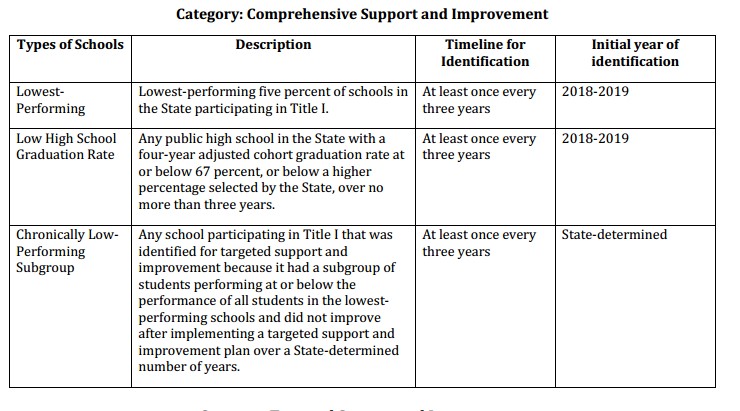
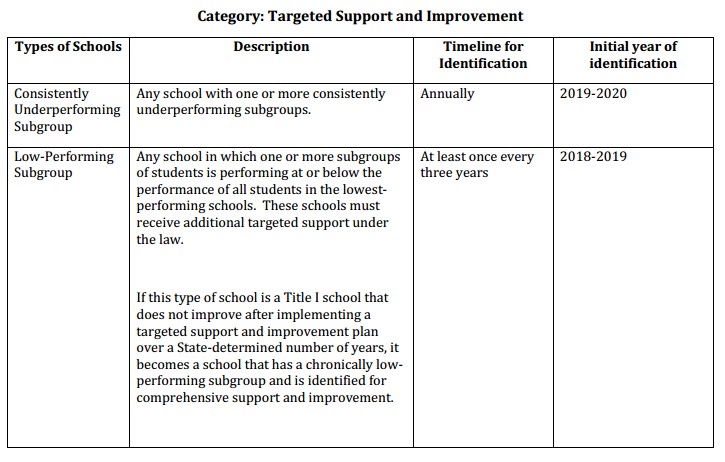
Highlights of key changes made in response to direct feedback from public comments are excerpted below from an announcement on U.S. Department of Education's website related to the release of final regulations in the Federal Register.
- "Timelines for Implementation of New Accountability Systems:
- Draft Regulations: In order to realize the potential of ESSA’s new multi-indicator accountability systems, the Department proposed that states implement new accountability systems and identify schools for “comprehensive support and improvement” under ESSA no later than the 2017-18 school year.
- Final Regulations: The Department has extended the timeline for states to identify schools for comprehensive support and improvement and additional targeted support and improvement until the 2018-19 school year, with a corresponding delay for identifying schools with “consistently underperforming” subgroups of students for targeted support and improvement until the 2019-20 school year. This change will provide more opportunity for meaningful stakeholder engagement in developing intervention plans and will allow states sufficient time to choose and consider new indicators of academic progress, English language proficiency, and school quality or student success. A state may implement earlier if they propose to do so in their approved state plan.
- Summative School Determinations and Data “Dashboards:”
- Draft Regulations: The proposal required that each state’s accountability system meaningfully differentiate schools by providing them with a summative rating, to provide clear information about the state’s overall view of a school from at least three categories and based on multiple indicators. To ensure a more nuanced picture of school performance, however, states were also required to report school performance on each of their chosen indicators.
- Final Regulations: In response to questions about the relationship between the summative rating requirement in the proposed regulations and the statutory requirement in ESSA to identify multiple types of schools for intervention, the Department has clarified that states may choose to use the determinations listed in the ESSA itself – comprehensive support and improvement, targeted support and improvement, and unidentified schools – as its summative determinations for schools. Alternatively, states may choose to provide other kinds of summative determinations, if states feel different categories of schools would help differentiate schools and share useful information with parents and stakeholders. In addition, the final regulations highlight that regardless of their summative determinations, states must also provide clear and understandable information to parents about school performance on each indicator individually to make it easier for parents and the public to understand whether schools are serving all students well. The final regulations also make clear that this information may be provided in a “data dashboard” or another user-friendly approach.
- Academic Progress and School Quality or Student Success Indicators
- Draft Regulations: The Department proposed that states demonstrate that each measure they select to use within indicators of (1) academic progress and (2) school quality or student success is supported by research that performance on that measure is related to increases in student achievement or graduation rates (for high schools).
- Final Regulations: The Department’s final regulations provides more flexibility and clarifies that any measure used in an indicator of academic progress and school quality or student success be supported by research that it helps increase student learning, such as grade point average, credit accumulation, or performance in advanced coursework, or for high schools, graduation rates, postsecondary enrollment, persistence, or completion, or career success. This ensures that the focus of accountability systems under ESSA can include a wide range of measures beyond test scores and emphasizes a holistic view of student and school success, without losing the focus on helping all students reach college and career readiness.
- Subgroup Accountability: N-Size Requirements
- Draft Regulations: The Department’s proposal did not specify a state’s minimum subgroup or n-size for accountability purposes, but required states to provide a justification if they propose to use an n-size of more than 30.
- Final Regulations: The final rules allow a state to propose any n-size, but maintains the requirement that states submit justification for n-sizes larger than 30 students, including data on the percentage of schools that would be accountable for subgroup performance at the proposed n-size compared to those that would be held accountable if the state had selected an n-size of 30. This will enable parents and the public to understand the implications of their states selecting larger n-sizes, but recognizes that an n-size lower than 30 is statistically valid and currently used by most states, and that requiring justifications for n-sizes less than 30 risks placing an increased administrative burden on states that have chosen n-sizes that are likely to meet all of the requirements for validity, reliability, and inclusion of student subgroups.
- Subgroup Accountability: Identification of Consistently Underperforming Subgroups
- Draft regulations: The proposal required states to identify schools with consistently underperforming subgroups based on their performance over no more than two years, with multiple options – including a state-developed option – for defining underperformance based on all accountability indicators.
- Final Regulations: The final rules maintain that subgroups should be identified after two years of consistent underperformance, as defined by the state, but allows states to propose a longer timeframe if they can show that the additional time will better support low-performing subgroups in making significant academic progress and closing statewide proficiency and graduation rate gaps. This change will ensure that students get the support they need in a timely manner while giving states more flexibility to identify and support struggling students. The final regulations also highlight that states may identify underperforming subgroups based on their state-developed goals and targets, but may also develop other definitions that consider all of the indicators.
- Incorporation of Assessment Participation Rates
- Draft Regulations: As required by ESSA, the proposed regulations reiterated that all students must participate in state assessments; and states must factor whether schools assess at least 95 percent of students – for all students and each subgroup – into their accountability systems to ensure fair accountability determinations, based on meaningful data about school performance. The proposed rules included some suggestions about how to do this, but also an option for states to develop their own “equally rigorous” proposals and for schools to design their own plans to improve participation in statewide assessments. In addition, districts must work with these schools to improve participation rates in the future.
- Final Regulations: The final rules retain options that states may choose to use, but allow more flexibility in the state-developed option for factoring participation rates into accountability systems, requiring states to develop “sufficiently rigorous” actions to improve school participation rates. This will allow states the flexibility to take into account nuances related to low participation rates, such as the extent to which a school missed the 95 percent requirement. Under the final regulations, districts must still develop plans with these schools to improve participation rates in the future.
- Timeline for Student Attainment of English Language Proficiency
- Draft regulations: The Department did not set a maximum timeline in which English learners must attain English language proficiency, but required states to take into account students’ initial level of proficiency when setting long-term goals.
- Final regulations: The final regulations require states to set a “researched-based”, maximum timeline for English learners to attain English language proficiency, but targets must be both rigorous and realistic to meet the diverse needs of the English learner population. This change will help ensure that states are setting reasonable expectations that are informed by evidence and encourage schools to help all English learners make sufficient progress each year toward English language proficiency so that students don’t languish for too long or receive services for too short a period of time."