Last week’s Internal Control Tip of Week article mentioned the need to build reasonable and sufficient internal controls in nearly aspect of the school district’s operations, programs and activities. A basic level of control is needed to provide an appropriate level of commonly used controls, including: (1.) Authorization; (2.) Review and approval; (3.) Verification; (4.) Reconciliations; (5.) Physical security over assets; (6.) Segregation of duties; (7.) Education, training and mentoring; (8.) Performance evaluations; and (9.) Periodic tests of controls.
There are a multitude of choices to consider when installing various controls, which causes school district officials to ask, “What level of controls are reasonable and sufficient for operations, programs or activities in question?” A key to prioritizing an additional focus on internal controls in certain areas should involve consideration of the incremental cost of establishing additional controls, in addition to the potential risk of failure and any related potential impact(s). Heavy-handedness in installing additional controls can be an inefficient investment of scare resources, slow down process completion times and add burdensome complexities. However, insufficient control levels can introduce undesirable levels of avoidable risk. The point is to strike the appropriate balance between a basic level controls versus ramped up levels of control that management may consider installing in certain areas.
A visual matrix can help guide decisions regarding the appropriate balance and the level of internal controls to maintain in various areas. For various operations, programs and activities, management needs to evaluate the relative impacts to the school district in relation to additional focus and installation of additional controls. The visual matrix below facilitates the evaluation of:
- Likelihood = the possibility that a given event will occur.
- Impact = the result or effect of an event.
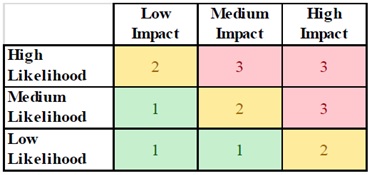
After evaluating the likelihood and relative impact, different levels of risk may be viewed as follows:
- 3 = High Risk – Mitigate or reduce the risks
- 2 = Medium Risk – Manage the risks
- 1 = Low Risk – Accept the risks
What are some of the impacts a school district may consider related to the visual matrix above? Various impacts may include:
- Safety – The importance of student and staff safety cannot be overstated.
- Health – The importance of student and staff health are self-explanatory.
- Academic performance – Internal control issues may have consequences that directly and indirectly affect student academic performance. For example, control issues that are associated with high operating costs in student support service areas will result in reduced resources available for the instructional classroom and various academic programs.
- Monetary – There are direct and indirect monetary-related consequences related to many internal control issues. An example of a direct consequence is the refund of grant funds due to various forms of noncompliance with grant-related law, rules or regulations. Another example of a direct consequence is the misappropriation of public funds or assets. An example of an indirect consequence is a decline in financial strength, which may result from any one of many factors that persist over time.
- Data quality issues – This consequence can result in the loss of local, state and federal funds. This consequence will also adversely affect various decision-making processes.
- Governance – This consequence may be associated with an ineffective governance component that may also be associated with a poor working relationship between the board and administration, in addition to frequent board meetings.
- Compliance – There are various levels of regulatory sanctions that may be applied by local, state and/or federal agencies against the district depending upon the degree of failure to adhere to law, rules, regulations and/or policies. In the most extreme case, this can mean refunding up to the entire amount of grant funds received or reductions applied to future grant funding. Compliance-related consequences are often associated with high legal bills.
- Accreditation - There are various levels of accreditation sanctions that will be applied against the district. The level of the sanction will depend upon the degree of low academic performance and/or failure to properly manage and administer the local school system in accordance with local, state and federal law, rule, regulations and/or policies. In the most extreme case, a lowered accreditation status may lead to eventual closure of the school system.
- Reputation or image – Every school system has competition and may experience a potential decline in student enrollment or lower enrollment growth, and loss of revenues when students transfer to other school systems, in addition to choices to enroll in private schools or choose homeschooling. Competition also results in the loss of teachers and other staff to other public school systems. Students and parents enjoy a high-level of school choice. Up to 30% of students in certain geographic areas are enrolled in school districts other than their district of residence.
School officials must make practical business decisions concerning the design and implementation of internal controls. No organization has enough resources to afford an absolute perfect level of internal control. So, management must make smart and prudent investments to achieve a desired level of diminished risk. In other words, there is a balance of costs and benefits that must be weighed by management. Viewing internal controls in the context of potential consequences if adequate levels of control are not installed helps put this topic in a more concrete perspective.